

The Joint Integrated Programme in Management Aptitude Test (JIPMAT) 2026 is scheduled to be held on 07 June 2026, giving aspirants a clear timeline for preparation. Conducted by the National Testing Agency (NTA), the exam serves as the admission gateway to the five-year Integrated Programme in Management offered by IIM Jammu and IIM Bodh Gaya. Both institutes accept JIPMAT scores for their full-time IPM courses, making it a crucial option for students aiming to pursue management education after Class 12.
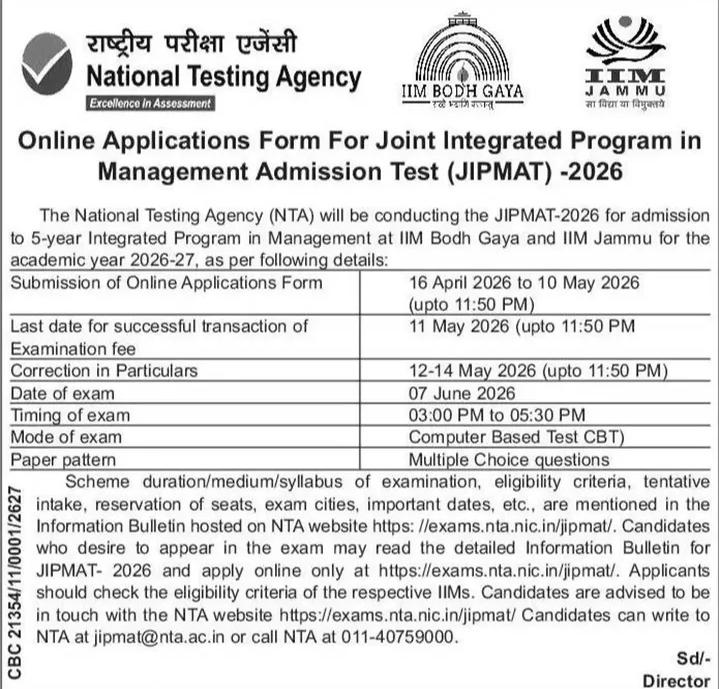
The online application process will be open from 16 April 2026 to 10 May 2026 (up to 11:50 PM). Candidates can complete the fee payment until 11 May 2026, allowing an additional day after form submission.
With the JIPMAT exam date now available, candidates can plan their preparation more effectively. The sections below cover important details, including JIPMAT 2026 exam dates, application process, exam timing, syllabus, and pattern to support a structured preparation approach.

JIPMAT 2026: Important Dates Announced
The timeline for JIPMAT 2026 has been finalised, outlining important stages from registration to exam day. Having a clear schedule allows candidates to organise their preparation, manage deadlines, and avoid last-minute issues during the application process.
To provide clarity, the complete timeline and exam details are outlined in the table below:
| JIPMAT 2026 | JIPMAT 2026 Important Dates |
|---|---|
| Application Form Release Date | 16 April 2026 |
| Last Date to Submit Application Form | 10 May 2026 (up to 11:50 PM) |
| Last Date for Fee Payment | 11 May 2026 (up to 11:50 PM) |
| Application Correction Window | 12 to 14 May 2026 (up to 11:50 PM) |
| Admit Card Release | Last week of May 2026 (expected) |
| JIPMAT 2026 Exam Date | 07 June 2026 |
| Exam Timing | 03:00 PM to 05:30 PM |
| Mode of Exam | Computer-Based Test (CBT) |
| Type of Questions | Multiple Choice Questions (MCQs) |
| Result Declaration | June 2026 (expected) |
Upcoming IPMAT Exams:
JIPMAT 2026 Exam Date and Time
The Joint Integrated Programme in Management Admission Test (JIPMAT) 2026 will be conducted on 07 June 2026 in Computer-Based Test (CBT) mode at designated centres across India. The exam will be held in a single afternoon shift, ensuring all candidates attempt the paper within the same time window.
| Exam Component for JIPMAT 2026 | Exam Details |
|---|---|
| JIPMAT Exam Date 2026 | 07 June 2026 |
| Shift | Afternoon (Single Shift) |
| Exam Timing | 03:00 PM to 05:30 PM (2 hours 30 minutes) |
| Gate Closing Time | 02:30 PM (strictly no entry after this time) |
| Mode of Exam | Computer-Based Test (CBT) |
Start your IPMAT preparation with expert-led Online IPMAT Coaching today.
JIPMAT 2026 Eligibility Criteria
To apply for JIPMAT 2026, candidates must meet specific academic requirements in Class 10 and Class 12. The exam is open to students from any stream, with no upper age limit. Eligibility is strictly based on marks, year of passing, and completion deadlines.
| Eligibility Criteria JIPMAT 2026 | Exam Details |
|---|---|
| Class 12 Qualification | Passed/appearing in Class 12/HSC or equivalent in 2024, 2025, or 2026 |
| Class 12 Minimum Marks | 60% aggregate (55% for SC/ST/PwD) |
| Completion Deadline | Class 12 must be completed by July 31, 2026 (provisional admission possible) |
| Class 10 Qualification | Passed in 2022 or later (some sources mention 2021; confirm with official bulletin) |
| Class 10 Minimum Marks | 60% aggregate (55% for SC/ST/PwD) |
| Age Limit | No upper age limit |
| Program Offered | Admission to the 5‑year Integrated Programme in Management (IPM 2026‑31) at IIM Bodh Gaya and IIM Jammu |
Additional Note:
IIM Jammu Selection Criteria: JIPMAT score carries 70% weightage, Class 10 marks 15%, and Class 12 marks 15%. Sectional cut‑offs apply in QA, DILR, and VARC.
Explore the Top 5 MBA Colleges in Gurgaon
JIPMAT Registration Process 2026
The registration for JIPMAT 2026 is conducted entirely online through the official portal of the National Testing Agency. No offline applications are accepted. A single application form covers admission to both the Indian Institute of Management Bodh Gaya and the Indian Institute of Management Jammu, so you do not need to submit separate forms.
To help you complete the process correctly, the step-by-step registration procedure is given below:
Step 1: Visit the Official Website
Access the NTA portal at exams.nta.nic.in/jipmat. The portal is the only authorised platform for JIPMAT registration.
Step 2: New Registration
Click on new registration to begin and create login credentials.
Step 3: Enter Basic Details
Provide your name, date of birth, valid email ID, and mobile number. Accuracy is important as these details will be used for communication and admit card generation.
Step 4: Generate Application Number
Submit the information to receive a system‑generated application number. Record the number immediately for future use.
Step 5: Create a Password and Log In
Set a secure password. Use the application number and password to log in to the portal.
Step 6: Fill the Application Form
Complete the application form by entering:
- Personal details
- Academic qualifications (Class 10 and Class 12)
- Category and PwD status (if applicable)
- Preferred exam cities
Step 7: Upload Documents
Complete the JIPMAT 2026 form by providing:
- Personal details
- Academic qualifications (Class 10 and 12)
- Category and PwD status (if applicable)
- Preferred exam cities
Step 8: Pay Application Fee
Pay the application fee online using net banking, UPI, or debit/credit cards. Ensure the transaction is successful before proceeding.
Step 9: Review and Submit
Verify all the details carefully before final submission. Only limited corrections will be allowed during the correction window.
Step 10: Download Confirmation Page
Download and print the confirmation page. The document serves as proof of successful registration and should be kept safe for future reference.
Youtube Video:
JIPMAT 2026 Registration Fee
The registration fee for JIPMAT 2026 depends on the candidate’s category. For Indian applicants, the fee ranges between ₹1,100 and ₹2,200, while Foreign/NRI candidates are required to pay ₹11,000. Registration began on April 16, 2026, and the deadline for submission and payment is expected by mid‑May 2026.
The category‑wise fee details are outlined below for clarity:
| Category | Application Fee |
|---|---|
| General / OBC (NCL) / EWS | ₹2,200 |
| SC / ST / PwD / Transgender | ₹1,100 |
| Foreign / NRI Candidates | ₹11,000 |
| Mode of Payment | Online (Net Banking, UPI, Credit Card, Debit Card) |
Documents Required for JIPMAT 2026 Registration
Candidates must keep the following documents ready while completing the JIPMAT 2026 registration process. Each document plays an important role in verifying eligibility, identity, and category status.
| Document for JIPMAT 2026 | Details of Requirement |
|---|---|
| Valid ID Proof | Aadhaar Card / Passport / PAN Card – government‑issued for identity verification |
| Class 10 Marksheet/Certificate | Proof of Date of Birth and basic academic qualification |
| Class 12 Marksheet/Certificate | Mandatory for eligibility; validates completion of higher secondary education |
| Scanned Passport‑size Photograph | Recent, colored, clear background; prescribed format for the admit card |
| Scanned Signature | On a plain white background, digital format for application authentication |
| Category Certificate (SC/ST/OBC‑NCL/EWS) | Required if applying under the reserved category; issued by the competent authority |
| PwD Certificate | Mandatory if claiming a reservation under Persons with Disabilities |
Must Know for Every IPMAT Aspirant:
JIPMAT Exam Pattern 2026
The JIPMAT 2026 will be conducted as a Computer‑Based Test (CBT) in English only. The total duration of the exam is 150 minutes (2 hours and 30 minutes). There is no sectional time limit, and candidates can move freely between sections during the exam.
The exam pattern aligns with the JIPMAT 2026 syllabus, assessing three core areas, Quantitative Aptitude, Data Interpretation & Logical Reasoning, and Verbal Ability & Reading Comprehension.
| Section | No. of Questions | Marks per Question | Total Marks |
|---|---|---|---|
| Quantitative Aptitude | 33 | 4 | 132 |
| Data Interpretation & Logical Reasoning | 33 | 4 | 132 |
| Verbal Ability & Reading Comprehension | 34 | 4 | 136 |
| Total | 100 | – | 400 |
JIPMAT Exam Pattern 2026: Marking Scheme
The JIPMAT exam follows a structured marking scheme designed to assess both accuracy and speed, closely aligned with the 2026. The paper consists of 100 multiple-choice questions divided across three sections, carrying a total of 400 marks.
| Section | Number of Questions | Marks per Question | Total Marks | Time Allotted |
|---|---|---|---|---|
| Quantitative Aptitude (QA) | 33 | +4, -1 | 132 | |
| Data Interpretation & Logical Reasoning (DILR) | 33 | +4, -1 | 132 | |
| Verbal Ability & Reading Comprehension (VARC) | 34 | +4, -1 | 136 | |
| Total | 100 | — | 400 | 150 minutes (overall) |
Marking Scheme of JIPMAT 2026
- Unattempted Question: 0 marks
- Correct Answer: +4 marks
- Incorrect Answer: –1 mark (negative marking)
Discover the Top 5 BBA Colleges in Delhi NCR
JIPMAT Exam Syllabus 2026
The latest JIPMAT Exam syllabus covers three major sections, each designed to test different skill sets required for admission to IIM Jammu and IIM Bodh Gaya.
| JIPMAT Sections | JIPMAT Syllabus 2026 Topics |
|---|---|
| Quantitative Aptitude (QA) | Percentages, Algebra, Number system, Time & Work, Ratio & Proportion, Geometry, Average, Profit & Loss, Mensuration, Simple & Compound Interest, Time-Speed-Distance, HCF & LCM |
| Data Interpretation & Logical Reasoning (DILR) | Puzzles, Tables, Coding-decoding, Bar graphs, Series, Caselets, Direction sense, Line graphs, Arrangements, Blood relations, Pie charts |
| Verbal Ability & Reading Comprehension (VARC) | Vocabulary, Reading comprehension, Synonyms, Sentence correction, Idioms & Phrases, Para jumbles, Antonyms, Tone, Grammar rules, Inference, Theme |
JIPMAT Exam Pattern 2026: Important Topics
The important topics in JIPMAT 2026 are directly aligned with the syllabus and represent areas from which questions are frequently asked. Understanding these topics helps candidates prioritise high-weightage areas and improve exam performance.
| Section | Topic / Category | Key Areas |
|---|---|---|
| Quantitative Aptitude (QA) | Number System | LCM, HCF, Factors, Multiples, Divisibility |
| Arithmetic | Percentages, Profit & Loss, Discount, Simple & Compound Interest, Averages | |
| Algebra | Linear Equations, Quadratic Equations, Identities | |
| Ratio & Proportion | Mixtures, Partnerships, Chain Rule | |
| Time & Work | Work Efficiency, Pipes & Cisterns | |
| Time, Speed & Distance | Boats & Streams, Relative Speed, Races | |
| Geometry & Mensuration | Area, Perimeter, Volume, Surface Area | |
| Data Sufficiency | Condition-based numerical problems | |
| Data Interpretation & Logical Reasoning (DILR) | Data Interpretation | Tables, Bar Graphs, Pie Charts, Line Graphs, Caselets |
| Logical Reasoning | Series, Blood Relations, Coding-Decoding, Direction Sense, Puzzles, Venn Diagrams | |
| Arrangements | Linear & Circular Arrangements, Distribution, Ranking | |
| Miscellaneous | Input-Output, Clocks & Calendars, Cubes & Dices, Non-verbal Reasoning | |
| Verbal Ability & Reading Comprehension (VARC) | Vocabulary | Synonyms, Antonyms, One-word Substitution, Contextual Meaning |
| Grammar | Nouns, Pronouns, Articles, Verbs, Tenses, Prepositions, Conjunctions | |
| Sentence Correction | Error Detection, Sentence Improvement, Fill in the Blanks | |
| Comprehension | Reading Passages, Tone, Theme, Inference, Central Idea, Title | |
| Verbal Logic | Para-jumbles, Sentence Arrangement, Odd One Out, Para-summary |

JIPMAT Exam: Difficulty Level (Expected)
Based on official trends and reliable analysis of JIPMAT 2025, the overall difficulty level of JIPMAT 2026 is expected to be Easy to Moderate. The exam is generally considered student‑friendly and more accessible compared to IPMAT Indore, as it avoids advanced mathematics and focuses on Class 10–12 concepts.
- Around 80% of questions are easy to moderate.
- About 20% of questions may be tricky or time‑consuming.
- Emphasis is on basic understanding, application, and speed, not advanced problem‑solving.
- No higher mathematics beyond Class 12 is asked.
To help you understand how difficulty varies across sections, the section-wise expected difficulty level is given below:
| Sections of JIPMAT Exam | Expected Difficulty Level |
|---|---|
| Quantitative Aptitude (QA) | Moderate (sometimes Moderate‑Difficult) |
| Data Interpretation & Logical Reasoning (DILR) | Easy to Moderate |
| Verbal Ability & Reading Comprehension (VARC) | Easy to Moderate |
Explore List of Top 9 BBA Colleges in Haryana
JIPMAT 2026 Preparation Strategy
Preparing for JIPMAT 2026 requires a structured and exam‑aligned approach. The exam consists of 100 MCQs to be solved in 150 minutes, with a marking scheme of +4 for correct answers and −1 for incorrect ones.
The overall difficulty level is expected to be Easy to Moderate. Quantitative Aptitude (QA) is generally the toughest section, Data Interpretation & Logical Reasoning (DILR) is usually the easiest, and Verbal Ability & Reading Comprehension (VARC) is predictable and scoring. Success depends on accuracy, speed, and clarity of concepts rather than attempting every question.
1. Understand the Exam & Set Targets
Understand the exam structure, focus on accuracy, and attempt only the right questions.
- Total Questions: 100
– Quantitative Aptitude 33 Questions, Data Interpretation & Logical Reasoning 33 Questions, Verbal Ability & Reading Comprehension 34 Questions
- Time: 150 minutes (no sectional timing, flexible allocation)
Target Good Attempts (85%+ accuracy):
- Quantitative Aptitude: 24 to 28 Questions
- Data Interpretation & Logical Reasoning: 28 to 31 Questions
- Verbal Ability & Reading Comprehension: 30 to 32 Questions
- Overall: 82 to 90+ competitive calls from the Indian Institute of Management Bodh Gaya and the Indian Institute of Management Jammu
2. Preparation Plan (7 to 8 Weeks Left)
A phased plan ensures balance between foundation building, practice, and mock testing.
Phase 1 (Next 3 to 4 weeks): Build Foundations
- Study 4–5 hours daily.
- Quantitative Aptitude: Revise Class 9 to 10 NCERT basics (Arithmetic, Algebra, Geometry, Numbers). Maintain a formula notebook.
- Data Interpretation & Logical Reasoning: Practice tables, graphs, puzzles, blood relations, and coding‑decoding.
- Verbal Ability & Reading Comprehension: Daily reading (editorials), vocabulary, grammar rules.
- Cover 70 to 80% of the syllabus.
Phase 2 (Next 2 to 3 weeks): Intensive Practice
- Solve 50 to 70 questions per section daily.
- Attempt sectional tests (1 hour each).
- Analyse mistakes and weak areas.
Phase 3 (Last 2 weeks): Mocks & Revision
- Take 2 to 3 full‑length mocks per week.
- Revise formulas, shortcuts, and error logs daily.
- Solve previous year papers (2025, 2024, 2023).
3. Section‑wise Strategy
Each section of the JIPMAT exam requires a focused and slightly different approach. You should adjust your preparation based on the nature and difficulty level of each section.
Quantitative Aptitude (33 Qs – Moderate, calculation‑heavy)
- High‑weightage topics are Percentages, Profit & Loss, Ratios, Time‑Speed‑Distance, Time & Work, Averages, SI/CI, Number System, Algebra, Geometry.
- Focus on strengthening basics, improving calculation speed, and solving 30–40 questions daily.
- Recommended resources include NCERT Class 9–10 and standard practice books.
Data Interpretation & Logical Reasoning (33 Qs – Easiest)
- Important topics are Tables, Bar and Pie Charts, Caselets, Puzzles, Sequencing, Blood Relations, Coding, and Syllogism.
- Build your strategy and practice 2 to 3 sets daily, learn to identify solvable sets quickly, and aim for near‑full attempts.
Verbal Ability & Reading Comprehension (34 Qs – Easy to Moderate)
- Practice Reading Comprehension Passages, Para‑jumbles, Sentence Correction, Vocabulary, and Grammar.
- Read daily editorials, build vocabulary (20 to 30 words per day), and practice Reading Comprehension with focus on inference and main idea.
Best Books and Study Material for JIPMAT 2026
Choosing the right books and resources is crucial for JIPMAT 2026 preparation.
Along with standard texts, the scope of JIPMAT test series is extremely important, as full‑length mocks and sectional tests simulate the actual exam environment and help improve speed, accuracy, and time management. Below are the most recommended books and study materials for each section, based on expert suggestions and recent exam trends.
| Subject | Recommended Books for JIPMAT |
|---|---|
| Quantitative Aptitude | NCERT Mathematics (Class 9 to 10) for basics; Quantitative Aptitude by R.S. Aggarwal; Arun Sharma (selective topics for advanced practice) |
| Data Interpretation & Logical Reasoning | A Modern Approach to Logical Reasoning by R.S. Aggarwal; Analytical Reasoning by M.K. Pandey; Practice sets from Hitbullseye/IMS/Career Launcher modules |
| Verbal Ability & Reading Comprehension | Word Power Made Easy by Norman Lewis; High School English Grammar & Composition by Wren & Martin; Daily reading of The Hindu/Indian Express editorials |
| Previous Year Papers & Mock Tests | Free and Premium Test Series of LPT EdTech |
| Coaching Study Packs | Hitbullseye JIPMAT Study Pack (concept videos, eBooks, assignments, mocks); IMS or Career Launcher JIPMAT‑specific modules |
JIPMAT 2026 Admit Card
The JIPMAT 2026 Admit Card will be released by the National Testing Agency (NTA) in late May or early June 2026 on the official website – jipmat.nta.ac.in.
Only registered candidates who have successfully completed the application process and paid the fee will be able to download their admit card once available.
Details Mentioned on the Admit Card
- Candidate’s name and photograph
- Roll number and application number
- Exam date and time
- Test centre name and address
- Exam day instructions
JIPMAT 2026 Result
The JIPMAT 2026 result will be declared by the National Testing Agency (NTA) in June–July 2026, most likely in early to mid‑July. The result will be released in the form of a scorecard on the official NTA portal , jipmat.nta.ac.in.
Only registered candidates who appeared for the exam can download their scorecard once available. No normalisation is applied since the exam is conducted in a single shift.
How to Download JIPMAT 2026 Scorecard
To access your JIPMAT 2026 result, follow the steps below to download the JIPMAT 2026 scorecard:
- Visit the official website: jipmat.nta.ac.in
- Click on the JIPMAT 2026 Score or Result/Scorecard link
- Log in using Application Number, Password, and Date of Birth
- View and download the PDF scorecard
- Take a printout for future reference
Result Calculation Process of JIPMAT 2026
NTA calculates the JIPMAT 2026 result using the final answer key after the challenge window (if any). The process is straightforward and transparent:
- Marking Scheme: +4 marks for correct answers, −1 mark for each incorrect answer, and 0 marks for unattempted questions
- Raw Score: (Correct answers × 4) − (Wrong answers × 1)
- Maximum Marks: 400 (100 questions × 4)
If any question is dropped, +4 marks are awarded to all candidates who attempted that question.
- Sectional scores are calculated separately, which is important for meeting the minimum sectional percentiles set by the Indian Institutes of Management.
- If percentile scores are released, they are calculated based on the overall performance of all candidates.
Explore the Complete About IIM Bangalore Courses
Colleges Accepting JIPMAT Score
JIPMAT is primarily conducted for admission to the 5‑Year Integrated Programme in Management (IPM) at two IIMs. In addition, a few other institutes also accept JIPMAT scores for their management programs.
| Colleges Accepting JIPMAT Score | Program | Seats (Approx.) | Additional Notes |
|---|---|---|---|
| IIM Bodh Gaya | 5‑Year IPM (BBA + MBA) | 120 | Main user of JIPMAT; merit list based on JIPMAT score and academics |
| IIM Jammu | 5‑Year IPM (BBA + MBA) | 140 | Merit list with high weightage to JIPMAT score, Class 10/12 and gender diversity |
| TAPMI Manipal (MAHE) | IPM / BBA Programs | Limited | Accepts JIPMAT as one of the entrance scores |
| NALSAR University of Law, Hyderabad | IPM / Management Program | Limited | Accepts JIPMAT scores |
JIPMAT 2026 Cut Off
The JIPMAT 2026 cut-off will depend on factors such as exam difficulty, total number of test‑takers, seat availability, and institute preferences at IIM Bodh Gaya and IIM Jammu.
Based on previous years’ analysis and expected trends, here are the projected cutoff ranges for different categories:
| Category | Expected Cut Off (Raw Score out of 400) |
|---|---|
| General | 310 to 350 |
| EWS | 280 to 330 |
| NC‑OBC | 280 to 310 |
| SC | 240 to 260 |
| ST | 200 to 240 |
| PwD | 220 to 250 |
Check the List of Top 10 MBA Colleges in Haryana
JIPMAT 2026 Preparation Tips
The JIPMAT 2026 exam (100 MCQs, 150 minutes, +4 for correct answers and −1 for incorrect, single shift on 7 June 2026) is expected to be easy to moderate overall. Quantitative Aptitude is generally the most time-consuming section, Data Interpretation & Logical Reasoning is comparatively more scoring, and Verbal Ability & Reading Comprehension remains moderate.
1. Know the Exam and Targets
Before starting preparation, it is important to understand the exam structure and set clear targets. The paper is divided into three sections, each with a fixed number of questions.
- Sections (Number of Questions):
– Quantitative Aptitude (33), Data Interpretation & Logical Reasoning (33), Verbal Ability & Reading Comprehension (34)
– Good Attempts (85%+ accuracy):
– Quantitative Aptitude: 24–28, Data Interpretation & Logical Reasoning: 28–31, Verbal Ability & Reading Comprehension: 30–32, Overall: 82–90+
- Target Strategy:
– Clear sectional percentiles first (General: 50; lower for reserved categories), then aim for a safe overall score (General: 320+).
2. Study Plan for 7 Weeks
A structured plan helps maintain consistency and ensures complete syllabus coverage.
- Daily Time Allocation:
Allocate 2 hours to Quantitative Aptitude, 1.5 hours to Data Interpretation & Logical Reasoning, 1 hour to Verbal Ability & Reading Comprehension, and 30–45 minutes to revision. - Weeks 1 to 2:
Focus on building fundamentals using NCERT for Quantitative Aptitude, along with grammar, vocabulary, and basic reasoning sets. - Weeks 3 to 5:
Shift to topic-wise practice and include sectional tests to improve speed and accuracy. - Weeks 6 to 7:
Attempt 2 tp 3 full-length mock tests per week, revise key concepts, and solve previous year questions (2024 and 2025).
3. Section-wise Tips
To prepare effectively, it is important to follow a section-wise approach based on the type of questions and difficulty level.
- Quantitative Aptitude
– Focus on Arithmetic topics such as Percentages, Ratios, Time & Work, Time-Speed-Distance, Averages, Simple & Compound Interest, and Mixtures. Then cover Number System, Algebra, and Geometry.
– Practice 30 to 50 questions daily and maintain a formula notebook and error log. Accuracy should be prioritised before speed.
- Data Interpretation & Logical Reasoning
– Practice question types such as tables, charts, caselets, puzzles, syllogism, blood relations, and seating arrangements.
– Solve 2 to 3 sets daily, identify solvable sets quickly, and aim for high accuracy.
- Verbal Ability & Reading Comprehension
– Read editorials from sources such as The Hindu or The Indian Express for 30–45 minutes daily. This helps improve comprehension and vocabulary.
Success in JIPMAT 2026 depends on balanced preparation, consistent practice, and smart exam strategy. With about seven weeks left, focus on building strong fundamentals, maintaining high accuracy, and practising mocks under timed conditions. Prioritise DILR and VARC for scoring stability, while steadily improving QA through daily practice and formula revision. Remember, the exam rewards clarity, accuracy, and confidence more than shortcuts. Use the extra preparation time wisely, track progress regularly, and approach exam day with calm focus and discipline.

FAQs on JIPMAT 2026
The admit card is expected in late May or early June 2026, about 7–15 days before the exam (scheduled for 7 June 2026).
NTA uses the final answer key. Each correct answer = 4 marks, each incorrect = −1 mark, unattempted = 0. Raw score is out of 400. Sectional scores are also reported.
No, since the exam is conducted in a single shift, normalisation is not required.
Primarily, IIM Bodh Gaya and IIM Jammu for their 5‑Year IPM programs. Some other institutes like TAPMI Manipal and NALSAR Hyderabad also accept JIPMAT scores.
Based on past trends, the General category cut‑off is expected around 310–350 marks. Lower ranges apply for EWS, OBC, SC, ST, and PwD categories.
Focus on QA (calculation‑heavy), DILR (scoring), and VARC (moderate). Practice PYQs, take mocks, maintain high accuracy, and revise formulas and grammar regularly.
Explore the top IPMAT Coaching Centres in India: